Flat fee recruiting is usually the better fit for volume hiring and international teams because it keeps the recruiting cost fixed. Percentage-based recruiting can still make sense for a one-off executive search, but the fee rises with the candidate's salary.
Let's talk about your hiring need
15 minutes to scope the role and see what a remote team could look like.
The right choice depends on three things: the role's salary, how many people you need to hire, and whether the recruiting partner also handles contracts, payroll, and HR. Here is how the two models compare.
What is flat fee recruiting?
Flat fee recruiting means you pay one agreed price per hire, regardless of the candidate's salary. It is also called fixed fee recruitment, flat rate recruitment, or pay per hire recruitment.
The model is simple:
- You define the role and the hiring scope.
- The recruiter sources and screens candidates.
- You pay the agreed fee when the placement meets the terms in your contract.
A $50,000 hire and a $90,000 hire can cost the same to place. That makes budgeting easier, especially if you are hiring several people in the same role category.
Flat fee staffing can cover more than candidate sourcing. For international hiring, check whether the quoted price includes screening, references, contracts, payroll, onboarding, compliance support, and a replacement guarantee.
How do percentage-based recruiting fees work?
Percentage-based recruiting charges a share of the placed candidate's first-year salary. Contingency recruiting fees commonly fall between 15% and 25%, while retained executive search fees often run between 30% and 35% and are paid in stages.
The math looks like this:
| Role | Salary | 15% fee | 20% fee | 25% fee |
|---|---|---|---|---|
| Customer service representative | $40,000 | $6,000 | $8,000 | $10,000 |
| Marketing specialist | $65,000 | $9,750 | $13,000 | $16,250 |
| Senior developer | $110,000 | $16,500 | $22,000 | $27,500 |
| VP of Sales | $160,000 | $24,000 | $32,000 | $40,000 |
The fee is not automatically bad. A percentage-based agency may invest substantial time in a difficult search and only get paid after a successful placement. The issue is that the cost grows even when the recruiting work is similar.
Flat fee recruiting vs. percentage-based: which costs less?
Flat fee recruiting costs less when the fixed price is below the percentage fee for the role. You can find the break-even salary with one calculation:
Break-even salary = flat recruiting fee divided by the percentage fee.
For example, a $5,000 flat fee breaks even against a 20% recruiting fee at a $25,000 salary. On a $60,000 salary, the percentage model costs $12,000, so the flat fee saves $7,000 for that placement. Five similar hires would create a $35,000 difference.
| Flat fee | Percentage fee | Break-even salary |
|---|---|---|
| $4,000 | 20% | $20,000 |
| $5,000 | 20% | $25,000 |
| $7,000 | 20% | $35,000 |
| $5,000 | 25% | $20,000 |
The calculation only compares recruiting fees. Add payroll, employer-of-record services, benefits, currency costs, and compliance work before deciding which offer is cheaper.
Recruiting agency fee structures compared
Each model solves a different hiring problem. Compare the commercial terms, not just the headline percentage.
| Model | Typical cost structure | Best fit | Main concern |
|---|---|---|---|
| Flat fee recruiting | Fixed price per hire | Volume hiring and international roles | Scope may vary between providers |
| Contingency recruiting | 15% to 25% of first-year salary | One-off roles with no upfront fee | Cost rises with salary |
| Retained search | 30% to 35% of expected salary, often in stages | C-suite and rare specializations | High total fee and upfront commitment |
| RPO | Monthly retainer or per-hire fee | Ongoing, high-volume recruiting | Requires a clear service scope |
| Subscription recruiter | Monthly flat fee | Teams hiring throughout the year | You may pay during quiet months |
What does a flat fee recruitment agency include?
A flat price is only useful when you know what you are buying. Ask for the scope in writing before you sign.
Sourcing and screening
Confirm whether the recruiter actively contacts candidates or only publishes job posts. Ask how skills, language ability, work history, references, and availability are checked.
Shortlisting
Ask how many qualified candidates you should expect and how quickly. A shortlist is useful only when each profile matches the role's actual requirements.
Contracts, payroll, and compliance
International hiring needs more than an introduction. Clarify who manages the employment contract, tax withholding, local labor rules, payroll, and currency payments. If the provider acts as an employer of record, ask which responsibilities stay with you.
Replacement guarantee
The guarantee should state its length, exclusions, and replacement process. A 30 day or 90 day guarantee is different from a 12 month guarantee, and voluntary departures may be treated differently from dismissals.
How international recruiting changes the cost calculation
International recruiting changes the comparison because the recruiting fee is only one part of the employment cost. You also need to assess local pay, employment compliance, payroll administration, language ability, time zone overlap, and management support.
Conexo hires English and French speaking professionals from more than 50 countries, including Madagascar, the Philippines, India, Morocco, Kenya, and countries across South America. Its global and remote staffing service covers sourcing, practical testing, employment, payroll, HR administration, and performance follow-up.
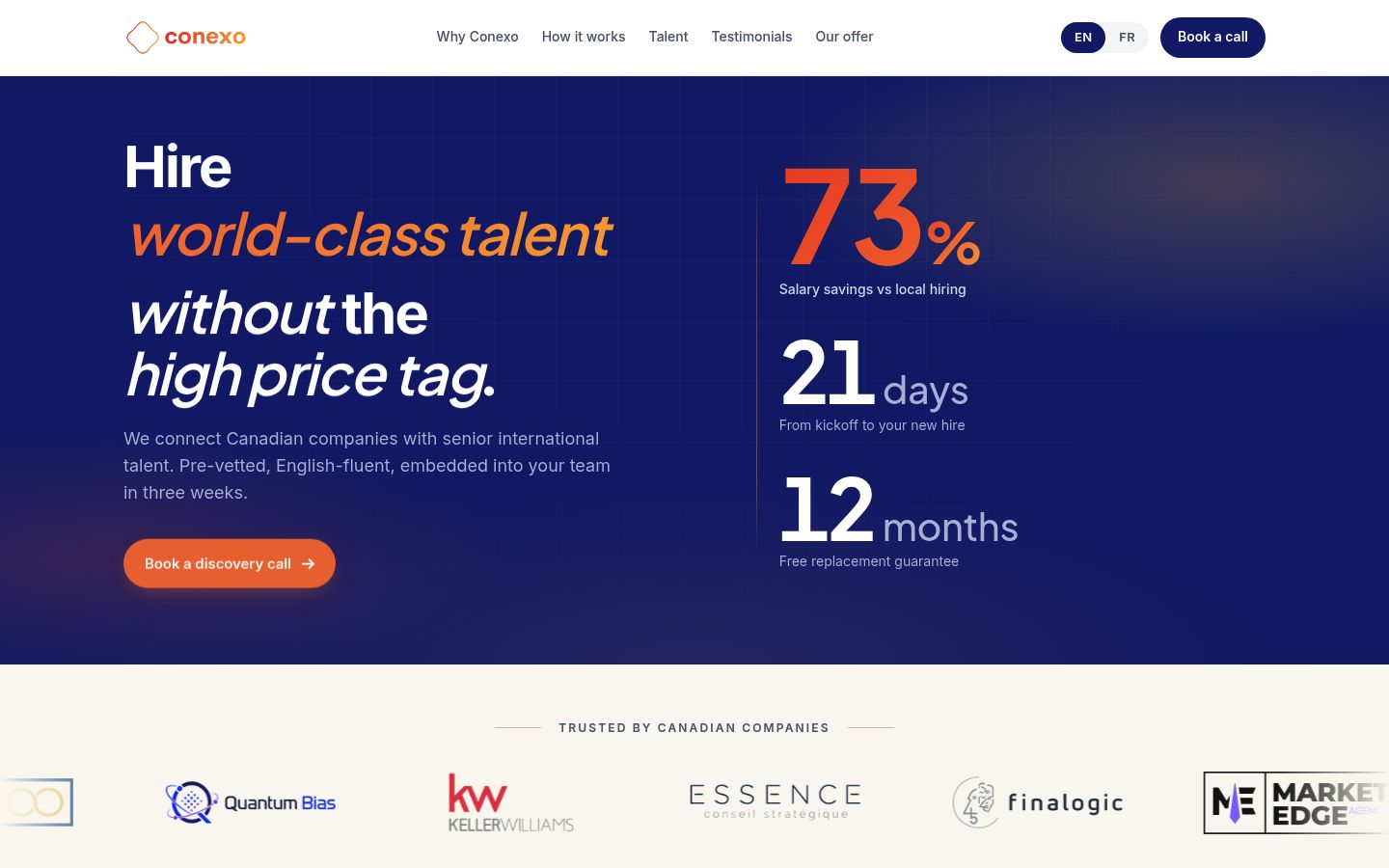
Conexo publishes rates starting at $11 CAD per hour and going up to $19 CAD per hour for specialized expertise on its service page. It also states that the first shortlist usually arrives within 3 to 4 weeks and that every placement includes a 12 month replacement guarantee. Treat those as the provider's published terms and confirm the current offer for your role before signing.
The structure is different from a traditional recruitment agency that stops after introducing a candidate. You receive one monthly invoice, while Conexo handles the employment relationship and payroll abroad. You keep operational control of the person's work.
For a broader view of the process, see how Conexo's remote staffing model works and the company's offshore staffing service.
What are the hidden costs of percentage-based recruiting?
Percentage fees are visible. The contract details around them may not be.
Check for these terms:
- Replacement limits. A short guarantee can leave you paying another full fee if the hire leaves soon after the guarantee ends.
- Re-engagement clauses. Some agreements charge a new fee if you hire a candidate again after a defined period.
- Candidate ownership. The contract may define how long the recruiter can claim a fee if you hire someone they introduced.
- Extra services. References, assessments, advertising, travel, and background checks may sit outside the placement fee.
- Salary basis. Confirm whether the percentage applies to base salary only or includes bonuses, commissions, and other compensation.
Flat fee agreements can have hidden costs too. A low quote may exclude international payroll, compliance, replacement hiring, or role-specific assessments. Ask for the full cost of the hiring process, not just the placement line.
How much do staffing agencies charge for direct hire?
For permanent direct hire, a staffing agency often charges 15% to 25% of first-year salary under a contingency arrangement. The exact fee depends on the role, location, specialization, exclusivity, and guarantee.
Retained search is different. You pay an agreed amount for the search itself, often in multiple installments, whether or not the search ends with a hire. That model can be suitable for confidential executive recruitment where the firm commits senior consultants and a dedicated research process.
Temp-to-perm hiring can add a conversion or buyout fee when a contractor becomes a full-time employee. Read that clause before starting the assignment so the eventual cost is clear.
Questions to ask before signing with a recruiter
Use these questions to compare a flat fee recruiter with a percentage-based agency:
- What is included in the fee, and what is billed separately?
- Does the fee apply to base salary, total compensation, or a fixed amount?
- Is the search exclusive?
- How many candidates will you present?
- What is the expected time to first shortlist and time to hire?
- Who handles assessments, references, contracts, payroll, and compliance?
- How long is the replacement guarantee?
- What happens if the role changes or the candidate declines the offer?
- Are there candidate ownership or re-engagement fees?
- What happens if you hire more than one person?
If the answers are vague, the price is not truly predictable.
Which model should you choose?
Choose flat fee recruiting when you want a fixed cost, plan to hire several people, or need an international staffing partner that stays involved after the introduction. It is usually easier to compare against a hiring budget because the fee does not rise with salary.
Choose percentage-based recruiting when you are filling one difficult role, want to avoid an upfront payment, or need a specialist executive search firm. The higher fee may be reasonable when the search requires deep industry access and a long confidential process.
For international teams, compare the complete employment model. A recruiter that only introduces candidates may have a lower placement fee but leave you to manage contracts, payroll, compliance, and replacement hiring. A global staffing partner may charge differently because it remains responsible for more of the employment process.
Bottom line
Flat fee recruiting is often the lower-cost option for roles above the break-even salary and for companies making multiple hires. Percentage-based recruiting remains useful for one-off senior searches where the agency is taking on significant search risk.
Before you choose, calculate the break-even point, list every included service, and check the replacement terms. For international hiring, add payroll, compliance, language, and ongoing management to the comparison.
FAQ
What is flat fee recruiting?
Flat fee recruiting is a hiring model where you pay a fixed amount per placement instead of a percentage of the candidate's salary. It is also called fixed fee recruitment, flat rate recruitment, or pay per hire recruitment.
Is flat fee recruiting cheaper than percentage-based recruiting?
It is cheaper when the fixed fee is below the percentage fee for the role. For example, a $5,000 flat fee costs less than a 20% fee once the candidate's salary exceeds $25,000, before any additional service costs.
How much do recruiting agencies typically charge?
Contingency recruiting agencies commonly charge 15% to 25% of first-year salary for permanent placements. Retained executive search firms often charge 30% to 35%, while flat fee recruiters set a fixed price based on the role and the services included.
What is a flat rate recruitment agency?
A flat rate recruitment agency charges one agreed price for a placement regardless of the candidate's salary. Confirm whether that price includes sourcing, screening, contracts, payroll, compliance, and replacement support.
What do staffing agencies charge for direct hire?
Direct-hire staffing agencies often charge 15% to 25% of first-year salary under a contingency model. The rate can change based on the role, specialization, location, exclusivity, and guarantee period.
How do staffing agency fees work for international hires?
International staffing fees may cover recruitment plus employment administration, payroll, compliance, and HR support. Compare the full monthly and one-time cost, because a low placement fee may exclude the work needed to employ someone across borders.
What should a recruiting agency guarantee cover?
A replacement guarantee should state how long it lasts, when it applies, and how the replacement process works. Ask whether it covers voluntary departures, dismissals, role changes, and repeated replacements.
Sources & References
- Conexo global and remote staffing: published staffing scope, rates, shortlist timing, and guarantee.
- Conexo: company positioning and international talent coverage.
- American Staffing Association: staffing industry research and terminology.
- U.S. Bureau of Labor Statistics: labor turnover and hiring context.