Skilled professionals in Lebanon cost 60 to 80% less than equivalent talent in North America or Europe. Salaries run $700 to $2,500 per month for remote roles. The talent pool is trilingual (Arabic, French, English), university-educated, and aligned to European and East Coast US time zones. This guide gives you the real numbers: salary benchmarks by role, how the three main hiring models compare, what Lebanese labor law actually requires, and how to avoid the compliance mistakes that most first-time international employers make.
Let's talk about your hiring need
15 minutes to scope the role and see what a remote team could look like.
Why Lebanon Has One of the Best Remote Talent Pools in MENA
Lebanon produced one of the Arab world's most sophisticated professional classes. For decades, Beirut's banking and finance sector drew talent that would rival any European financial hub. The advertising industry was the largest in the Arab world. Universities in Lebanon have among the highest enrollment rates in the region, with many graduates trained in France, the US, or the UK before returning home.
The country's economic crisis since 2019 has pushed salaries to levels far below the regional average. That's a hard reality for Lebanese professionals. For international employers, it creates an opening to hire deeply qualified people at a fraction of what the same profile would cost elsewhere.
According to a July 2026 ILO report on Lebanon's labour market, one in three private sector workers in Lebanon is no longer employed. The candidate pool includes experienced professionals in their prime, not just junior talent looking for a first opportunity.
Lebanon Salary Benchmarks for Remote Roles (2026)
These are typical monthly gross figures in USD for remote positions filled through an international staffing partner:
| Role | Lebanon (Monthly) | North America Equivalent | Savings |
|---|---|---|---|
| Software developer (mid-level) | $1,500 – $2,500 | $7,000 – $9,500 | ~75% |
| Financial analyst | $1,200 – $2,000 | $5,500 – $7,500 | ~73% |
| Digital marketing specialist | $900 – $1,600 | $4,500 – $6,000 | ~74% |
| Executive assistant | $700 – $1,200 | $3,500 – $5,000 | ~75% |
| Customer support (bilingual) | $600 – $1,000 | $3,000 – $4,500 | ~78% |
Most Lebanese professionals working for international employers negotiate compensation in USD. Since 2019, the Lebanese pound has lost over 90% of its value, so USD-denominated contracts are standard and expected on both sides.
On top of salary, budget for service costs. Staffing agencies typically charge either a one-time placement fee (10 to 20% of annual salary) or a monthly managed fee that covers payroll and HR administration.
The Three Hiring Models: Costs, Risks, and Time to Hire
1. Direct Hire
You post the role, run your own screening, and hire directly. You'll need either a locally compliant employment contract or a solid independent contractor agreement.
Cost: Salary only, plus employer social security contributions of approximately 23.5% of gross salary through Lebanon's National Social Security Fund (NSSF).
Risk: High. Lebanon's labor law is enforced inconsistently, but the obligations are real: 15 to 18 days paid annual leave, a 48-hour maximum work week, end-of-service indemnity equivalent to one month's salary per year worked, and probation periods of up to 12 months for qualified professionals. Getting any of these wrong creates liability.
Time to hire: 4 to 8 weeks.
Best for: Teams with experienced in-house HR and clear familiarity with Lebanese employment law.
2. Recruitment Agency (Placement Fee Model)
An agency sources, screens, and presents candidates. You hire directly and handle payroll yourself.
Cost: One-time fee of 10 to 20% of first-year salary. For a $20,000/year hire, that's $2,000 to $4,000 upfront. You still carry employer NSSF contributions after placement.
Risk: Medium. The agency removes the sourcing burden, but compliance and payroll remain your responsibility.
Time to hire: 2 to 4 weeks.
Best for: One-off senior hires where you want a vetted shortlist without running the search.
Expertise Recruitment is one of the established local agencies for mid-to-senior roles, with 17 years of operations across Lebanon and the wider Middle East.

3. International Staffing Partner (Fully Managed)
An international agency handles everything: sourcing, vetting, onboarding, monthly payroll, and ongoing HR management. You get a dedicated hire embedded in your team without setting up any local infrastructure.
Cost: A monthly managed fee on top of salary. For a $1,500/month hire through Conexo, the all-in monthly cost runs $1,800 to $2,200 depending on role complexity. There's no upfront recruitment fee you pay separately from the deposit, which is credited toward the total.
Risk: Low. The agency carries the employment relationship, compliance responsibility, and offers a 12-month replacement guarantee if the hire doesn't work out.
Time to hire: 3 to 4 weeks.
Best for: Companies building their first international remote team or organizations that want a proven process without any local legal exposure.
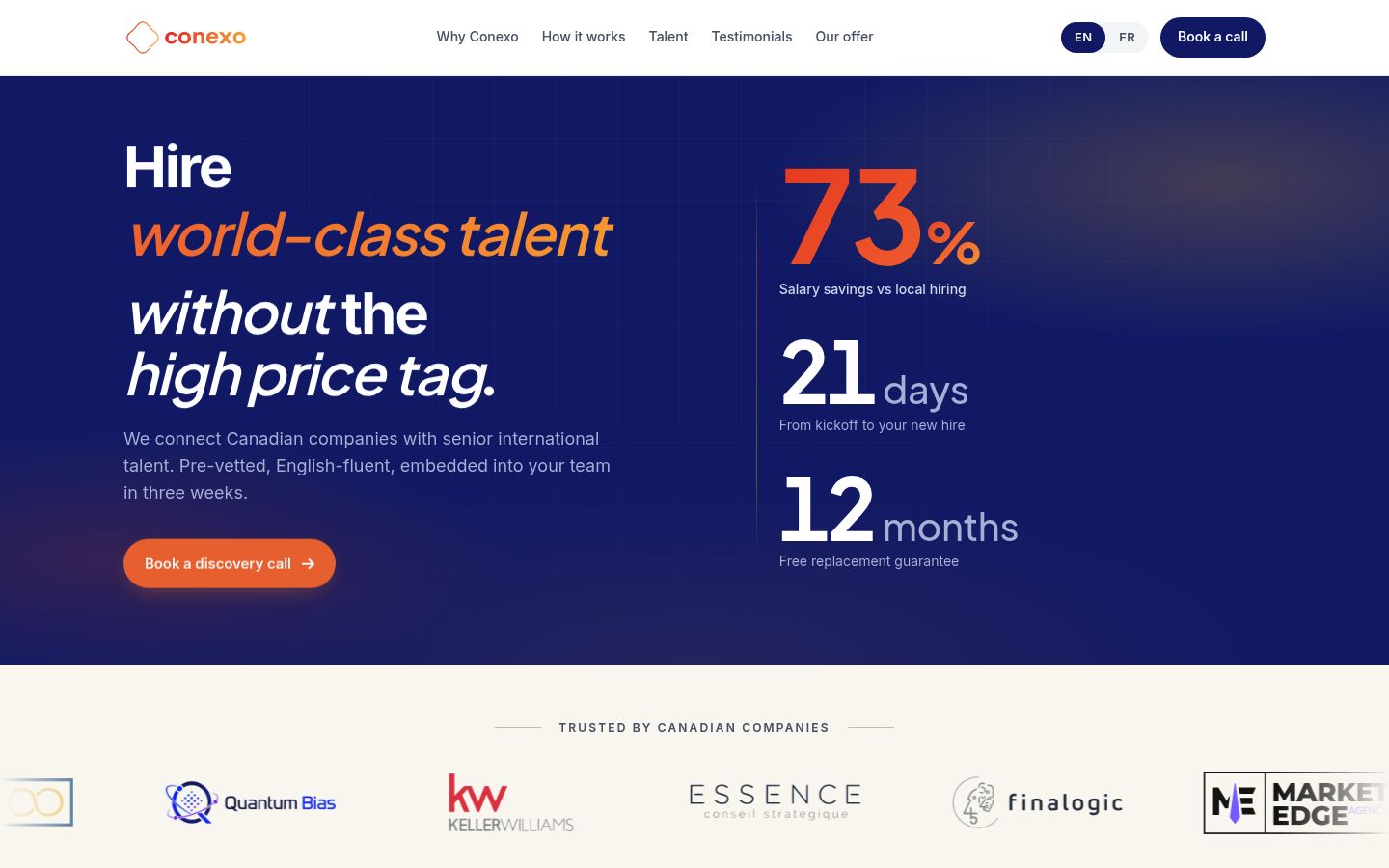
This is the model most international employers use when hiring from Lebanon for the first time. Conexo recruits from over 50 countries worldwide, including Lebanon, and manages the entire employment relationship on the back end.
Side-by-Side Comparison
| Model | Setup Cost | Monthly Cost ($1,500/mo hire) | Legal Risk | Time to Hire |
|---|---|---|---|---|
| Direct hire | $0 | ~$1,850 (salary + NSSF) | High | 4–8 weeks |
| Local agency (placement) | $2,000–$4,000 | ~$1,850 (salary + NSSF) | Medium | 2–4 weeks |
| International staffing partner | $0 upfront | ~$1,800–$2,200 all-in | Low | 3–4 weeks |
The international staffing model costs slightly more per month than direct hire, but eliminates setup complexity, removes legal exposure, and typically includes a replacement guarantee.
Lebanese Labor Law: What International Employers Need to Know
Lebanon's Labor Law dates to 1946 with subsequent amendments. For remote hires, these are the facts that matter:
- Work hours: 48 hours per week is the legal maximum. Overtime is paid at 1.5x the hourly rate.
- Annual leave: 15 days minimum per year for employees with under three years of service, rising to 18 days after year three.
- End-of-service indemnity: Employees who complete one year are entitled to one month's salary per year worked. This is a material termination cost that many first-time employers don't account for.
- Probation: Up to 12 months for qualified professionals.
- NSSF contributions: Employer contributions run approximately 23.5% of gross salary, covering health, maternity, and family allowances.
For remote contractors (as opposed to full employees), a clearly drafted service agreement removes most of these obligations. The misclassification risk is real, though. If someone works exclusively for you, follows your hours, and uses your tools and accounts, Lebanese courts can reclassify the relationship as employment.
According to RecruitOutsource's Lebanon EOR guide, international companies hiring in Lebanon without a local entity typically use an Employer of Record (EOR) arrangement to stay compliant. The EOR holds the local employment contract while the client company directs the work.
What Roles You'll Actually Find in Lebanon
Lebanon's strength is concentrated in knowledge work. The sectors with the deepest remote-ready talent pools are:
Technology: Full-stack developers, mobile engineers, QA specialists, and data analysts. Many Lebanese developers trained abroad and returned home, bringing Western standards and communication norms. Mid-level developers run $1,500 to $2,500 per month.
Finance and accounting: Before 2019, Lebanon had one of the most developed banking sectors in the Arab world. That created a large pool of trained accountants, CFAs, and financial modelers now available for remote finance roles at $1,200 to $2,000 per month.
Marketing and creative: Bilingual and trilingual copywriters, digital marketers, graphic designers, and video editors. Beirut's advertising industry was historically the largest in the Arab world. Budget $900 to $1,600 per month for a capable digital marketing specialist.
Customer support: Trilingual agents (Arabic, French, English) for Middle East, North Africa, and European-facing businesses. Lebanese customer service professionals have backgrounds in high-end financial and hospitality sectors, which translates directly to professional tone and judgment.
Executive support: Bilingual executive assistants at $700 to $1,200 per month. Rare at this price point in any other market with this level of business fluency.
How to Find Recruitment Agencies in Lebanon
Two categories apply here, and they serve different needs.
Local Lebanese agencies are built for in-country placements: physical presence in Beirut, roles that require being on-site, executive search for regional positions. Expertise Recruitment has operated for 17 years across Lebanon and the broader Middle East. Local directories like Kompass Lebanon list registered staffing firms for those who want to compare options.
International staffing partners with Lebanon reach are better for remote hires. They handle cross-border payroll and compliance from the start without requiring you to build local HR capability. Conexo sources from Lebanon as part of its 50-country global network, with bilingual (English and French) support that matters when working with Lebanese professionals who often operate in both.
The key difference: a local agency delivers a shortlist of candidates. An international staffing partner delivers a hire who arrives ready to work, with the employment infrastructure already in place.
Screening Criteria That Predict Remote Success from Lebanon
Standard interviews aren't enough. These are the things to verify specifically for Lebanon hires:
Written English fluency: Most educated Lebanese professionals speak conversational English well. Written fluency for professional documents varies more. Test it in the screening process with a short written task, not just the CV.
Time zone fit: Lebanon is UTC+2 (EET) in winter and UTC+3 (EEST) in summer. This aligns cleanly with European teams and East Coast US morning hours. It's a harder fit for West Coast-heavy teams expecting afternoon overlap.
Power and internet backup: Lebanon has experienced significant infrastructure instability. A reliable candidate will already have an uninterruptible power supply (UPS) or generator access and a secondary internet connection. Ask about this directly. Candidates who haven't solved the problem yet will be the ones who go dark during your team calls.
Contract structure clarity: Lebanese nationals working remotely for a foreign company are generally not subject to Lebanese work permit requirements. But if payroll runs through an EOR, confirm the EOR has proper local registration and can issue compliant employment documentation.
FAQ
What does it cost to hire a remote employee from Lebanon?
Plan on $700 to $2,500 per month in gross salary depending on role and seniority. Add employer NSSF contributions of approximately 23.5% if you're employing directly. Through an international staffing partner like Conexo, the all-in monthly cost typically runs 20 to 40% above base salary, covering payroll, compliance, and ongoing HR management.
What are the best recruitment agencies in Lebanon for international employers?
International employers building remote teams generally get better results from global staffing firms with Lebanon reach rather than purely local agencies. Local agencies like Expertise Recruitment are strong for in-country or regional placements. For cross-border remote hires, an international partner that handles payroll and compliance from day one saves significant setup time and legal exposure.
What is an Employer of Record (EOR) in Lebanon?
An EOR is a company that holds the formal employment contract with your hire in Lebanon, managing local payroll, NSSF contributions, and labor law compliance on your behalf. You direct the work; the EOR manages the employment relationship. This lets international companies hire in Lebanon without establishing a local legal entity. Conexo operates this model across its global network.
Can I hire a Lebanese professional as an independent contractor?
Yes, and many international companies do. A contractor structure avoids NSSF obligations and end-of-service indemnity. The misclassification risk is real, though: if the working arrangement looks like employment (exclusive relationship, set hours, use of employer tools), Lebanese courts can reclassify it. Use a clear service agreement, pay invoices rather than salary, and avoid imposing fixed work schedules.
How do Lebanese professionals compare to other MENA remote talent?
Lebanese professionals rank among the highest in the Arab world for language fluency and professional qualifications. Arabic, French, and English together is a rare combination that's directly valuable for companies serving European or MENA markets. The main practical challenge is infrastructure reliability. Good candidates already manage this proactively with backup power and internet solutions.
What roles are easiest to fill from Lebanon?
Technology (developers, QA engineers), finance and accounting, bilingual customer service, digital marketing, and creative roles (design, video, copywriting) have the largest candidate pools. Executive and senior management positions have smaller pipelines but are accessible through specialist search. Conexo's Lebanon network covers all of these categories.
How long does remote hiring from Lebanon take?
Direct hire takes 4 to 8 weeks if you run your own process. A placement-fee agency typically delivers a shortlist in 2 to 4 weeks. An international staffing partner like Conexo presents the first wave of vetted candidates within 3 to 4 weeks from kickoff, with the full process including onboarding running 4 to 6 weeks total.
Do I need a local entity to hire in Lebanon?
No. International companies can hire Lebanese talent through an EOR arrangement without establishing a Lebanese legal entity. The EOR holds the local employment contract and manages compliance. This is the standard approach for foreign employers building remote teams from Lebanon.
Sources & References
- ILO: Lebanon's Labour Market in Crisis (July 2026) — ILO data on private sector employment impacts from renewed conflict
- ILO Lebanon Country Page — Labour standards and employment statistics for Lebanon
- RecruitOutsource: Lebanon EOR & Employer Guide — EOR structure and Lebanese labor law overview for international employers
- Expertise Recruitment — Lebanon-based recruitment agency for mid-to-senior roles
- Kompass Lebanon: Staffing Agency Directory — Registered recruitment firms in Lebanon
- Conexo: International Talent Acquisition — Managed staffing model with 50-country reach including Lebanon